top of page
Investigative reporter. Data journalist.
Photography
 Food scarce in harsh Chicago winterStacks of donated food sit idle before the pantry doors open at 5:45 p.m. on Feb. 9. Volunteers at the Coppin Community Center remain poised before the chaos. Frankye Parham, the food pantry coordinator at the center, says they see between 120 and 220 guests each Monday. |  Antoinette McGruder (pictured left) walks through the pantry line and decides which type of bread to take home. McGruder and her husband frequent the pantry twice a month. “We got here 11 o’clock, we’ve been out here ever since,” McGruder says. Monday’s temperature peaked at 31 degrees. |  Snow makes the utilizing the service more difficult, says Frenchie McGruder, a formerly homeless local resident who has been coming to the pantry for about nine months. “It’s always tough, but it’s tougher in the winter because your ability to get around is compromised,” he says. On Monday, Feb. 2, the city’s fifth largest snowstorm caused the pantry’s doors to remain shut. |
|---|---|---|
 The food, donated by local grocery stores and delivered by the Greater Chicago Food Depository, is noticeably different in the wintertime, says Parham, who has run the weekly program since its conception over two years ago. “In the summer I have so much produce, fresh produce,” Parham says. “But in the winter, it’s kind of [tough], getting fresh produce in here. And they need that.” |  At most stations, attendees can choose food items they prefer. The food is available to residents in three local zip codes: 60637, 60621 and 60615. “It’s mostly clients with children,” Parham says. | 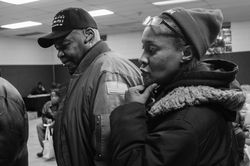 Some residents, like Tania Hayes (pictured right), made the most of the long line. Hayes swayed to the music blaring from the speakers near the entrance. She says the pantry is an opportunity to meet up with her son, who also uses the service. |
 “Food insecurity is more than just the lack of food,” Parham says. “Food insecurity is not having a job to get that food. Maybe having some social issues that prevent you from getting that job.” She says these issues need to be addressed. “We fill a void, but it’s just the tip of the iceberg,” Parham says. |
 Knitting makes a comebackNina: a well-knit shop sits in Chicago’s Wicker Park neighborhood. A tree outside is blanketed in a colorful yarn wrap. The store, selling knitting and crocheting supplies, is a weekend hangout for some in the local knitting community. |  Owner Nina Rubin says a neighbor taught her to knit in high school. Growing up in a small town, Rubin says she remembers buying her yarn from a local sheep farm. |  Rubin goes to find supplies for some customers. “I love the color and texture and sort of that quiet of knitting,” Rubin says. “It’s very relaxing.” Because the store can get hectic at times, Rubin says she isn’t able to knit much at the store. |
|---|---|---|
 “I knew there were lots of people who were hungry for more modern shops,” Rubin says of her decision to open the store. She planned to create a place with a contemporary feel for knitters who wanted to create new, fashionable items. |  Tami Kucera, left, and Olia Huminiak working on different scarf patterns. Huminiak comes in with a Starbucks drink and some yarn to knit on the weekends. “We know each other and we just kind of show up here,” she says of the group. |  Amy Gawura works on a project at the shop. “This is my peaceful time,” she says. “I have two kittens at home.” Gawura says she comes here to talk with fellow knitters and to work without distractions. |
 Rubin balls up some blue yarn while chatting with a customer. Rubin says that although knitting can be a solitary pastime, there is definitely a social element to it. When customers come in, they talk about projects, which leads to questions and conversations about what and why they’re knitting items, she says. |  Rubin says the knitting in her shop is definitely influenced by the community. Originally the store got a lot of young customers, but now it’s a lot of people with strollers and dogs, Rubin says. |  Rubin says she does still do a lot of knitting at home. Pieces all around the store are projects of hers. Gawura says knitting can be addictive. “Once you start, it’s hard to stop,” she says. |
bottom of page